A week of fieldwork in Colombia’s Cauca Valley and Antioquia—operational centers of the Cali and Medellín cartels in the early days of cocaine revolutions—reminded us of the urgency of stepping outside our analytical comfort zone to examine a reality that does not always fit the theoretical frameworks we try to impose on it.
Being on the ground involves listening, observing, and moving through spaces of contested governance, where the state is more of an idea than a presence, yet it remains the primary reference point to understand what is happening, something we have tried to do after more than four decades working in these regions.
In a very real sense, everything has changed in Cali and Medellín since the halcyon days of the 1980s and 1990s, when the cartels successively waged war on the state or simply bought a presidential election. The historical leaders that were the innovators of two of the most disruptive waves of transnational organized crime in recent centuries are mostly dead, with a few still serving time in U.S. prisons, and the new generation has a much lower public profile.
Medellín has a modern metro, cable cars and moving stairways to whisk residents and tourists above the twisty roads of the steep mountains to the infamous Comuna 13 that was home to Pablo Escobar’s notorious sicario army of hitmen that wreaked havoc in the city. Now the city and its environs are booming with tourism and investments. In the Northern Cauca Valley and the city of Cali, the Rodriguez Orejuela brothers, with their ostentatious mansions and private clubs, are gone, and the ultra-violent Northern Valley group, built on inter-married clan structures, has faded into ghosts. But sugar cane production, construction and cattle ranching continue apace.
Yet in many ways, nothing has changed except the desire for public recognition of the cartels. Colombia remains a living laboratory of what we have been describing as extralegal or contested governance. It is not simply a matter of the state’s absence, but rather something more complex: territories where the state’s presence is fragmented, abusive of the population, allied with criminal interests, intermittent, or where it simply chooses not to intervene—and that vacuum is quickly filled by criminal structures that not only perpetrate violence but also provide a framework for organizing daily life.
This is the point that is often missed. These organizations do not impose themselves solely through fear. Our earlier discussions of Community Embedded Transnational Armed Groups (CETAGs) were an effort to understand those groups between local gangs and cartels that control space and thrive, in part, because of the local legitimacy their governance has.
In both regions visited this is the case. The most visible, tangible structures have morphed into more muted but equally powerful hybrid criminal-state symbiotic relationships that retain many of the basic elements of earlier times.
What these structures do is produce order, often accompanied by economic benefits. They manage conflicts, regulate economies, establish rules, and, in many cases, achieve levels of social acceptance that the state long ago ceased to have. They do not replicate the state; they replace it. And they do so with an efficiency that defies any simplistic interpretation based exclusively on paradigms of repression or police control.
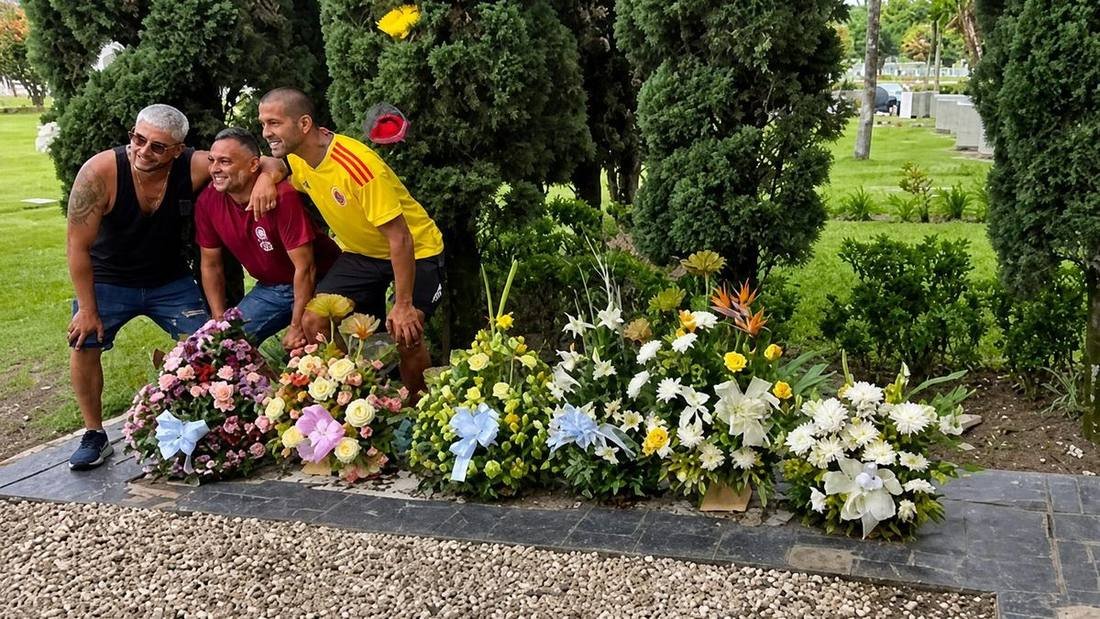
Thus the structures mutate and endure, now not as violent, not as visible as a political or economic force, but more deeply rooted than ever, with strong religious underpinnings. This is seen in the thousands of visitors to the Medellín Cartel’s Maria Rosa Mística virgin—darkened by candle smoke in a small grotto during Escobar’s time, now a towering, glass-encased, regally robed statue—surrounded by thousands of thank-you mosaics for the miracles she has provided; the thousands of pilgrims and tourists to the grave of Pablo Escobar; and the flow of visitors to the Basílica del Señor de los Milagros in Buga, on the outskirts of Cali, where the Cali cartel leaders and now others receive divine miracles.
In the current context in Colombia it is impossible to ignore the fact that the issues of governance and legitimacy are not defined solely by a dichotomy between the state and criminal structures. There is an increasingly broad gray zone where the legal and the illegal merge and cease to be separate categories. Officials, judicial actors, economic actors, and formal structures, by acts of commission or omission, end up being part of the equation. Not always through direct corruption, but through more subtle forms of adaptation, coexistence, or simply survival.
That is where state intervention to establish legitimacy becomes complex, as in the Northern Valley in Cauca with its growing violence echoing earlier days of Colombia’s 52-year civil war, or growing parts of Medellín under control of expanding criminal gangs. The state is not fighting an external enemy or an internal enemy defined by ideology. It is failing to understand the new order of a system where boundaries are blurred and where institutions become integrated into these dynamics.
Amid all this are the victims and survivors, communities that have learned to live under these shifting rules; the urban underclass whose members have been viewed by the shifting power structures as disposable; Indigenous and Afro-descendant populations that have historically been displaced; women facing normalized structural violence; young people who see criminal economies not as an option, but as the only available alternative. These are territories where crime is not an outside intruder but rather a part of the landscape.
And there lies a fundamental problem that we see not only in Medellín and Cali, but across Latin America: public policies that continue to be conceived and implemented from afar—from offices, from cities, from assumptions that fail to capture territorial complexity. Homogeneous solutions that are designed for profoundly different realities. The result is often state intervention that not only fails but ends up being irrelevant.
This is why in our projects the Resilience Collaborative prioritizes fieldwork, recognizing that there is no way to understand contemporary organized crime without a presence on the ground. Desk research has obvious limitations when what is at stake are rapidly shifting dynamics built on daily interactions, unwritten codes, and power relations that are not always visible.
In this context, local networks become the foundation of the work. Journalists, researchers, social organizations and human rights defenders operate under complex, often risky conditions, and provide access to a layer of information that simply does not exist in formal records. Without these networks, no investigation is possible. And more importantly, there is no real understanding of the territory.
Resilience in the face of organized crime is not built solely through security or traditional public policy. It is built through situated knowledge that, when taken together, presents a more complex and accurate understanding of criminal dynamics, contested governance and legitimacy to govern. Through the ability to understand how these structures operate in specific contexts, how they relate to the community, and how they insert themselves into formal and informal economies, we can find patterns, networks and models to understand the new world order.
And, above all, through the will to make visible what has become functionally invisible. Organized crime does not necessarily hide; it is increasingly able to blend in, learning to operate in spaces where no one wants to look too closely. Where complexity is too uncomfortable to investigate, where responsibilities are diluted, and where the line between what is permitted and what is prohibited becomes increasingly difficult to draw.
The work in Colombia does not provide any definitive answers. On the contrary, it raises more questions than it answers that are not confined to public security policies but illustrate a much deeper fracturing over territorial control and governance, legitimacy, and, in many cases, the very meaning of what we understand by “the State” in certain territories.
And that is a discussion we are not yet having with the depth it requires.