The desperate trail trod by tens of thousands of migrants, smugglers, and transients from southern Nicaragua into northern Costa Rica is impossible to miss. The permanently muddy path around an ancient wall built to stem the flow of people is littered with the debris of desperate travelers–thousands of shoes, including many of children who likely did not survive; piles of plastic water and soda bottles consumed in the tropical heat; mounds of trash holding food wrappers, rotted back packs and personal items once held dear.
A few miles away the San Juan River forms the nebulous border between Nicaragua, under the brutal rule of Daniel Ortega and his wife and co-president Rosario Murillo, and Costa Rica, the fading beacon of democratic governance in Central America. In decades past U.S. backed Contra rebels, along with the Sandinista troops they were fighting, crisscrossed this area where U.S. cattle ranchers and entrepreneurs turned enormous war-time profits. The profit centers are now human beings, illicit gold ingots and drugs.
Fieldwork around the border town of Los Chiles, shows that in this sweltering border crossing, marked by a simple cement marker with “Costa Rica” on one side and the other blank because the “Nicaragua” plaque was destroyed is, in reality, a critical part of an expansive ecosystem of illicit pathways where the states on either side of the border have little real control.
Los Chiles is the hamlet with the lowest human development index in Costa Rica. Just a few hundred meters from the formal and vacant Las Tablillas border control, the trails are alive with pilgrims in both directions—those seeking work going south to less stifling economic opportunities or smuggling valuable gold and contraband, and north with smugglers of scarce consumer goods heading into Nicaragua, a state that increasingly resembles North Korea for its absolute control of its citizens.
Formal border crossing come at a high cost: Nicaragua charges a transit fee that most cannot afford, constricts travel and Costa Rican officials often extort travelers coming and going. The informal coyote system is safer and more reliable, bypassing the state. The coyote networks—both Nicaraguans and Costa Ricans—are controlled by a local structure that calls itself “the Taliban.”
In February 2026, Costa Rican authorities dismantled the organization, at least on paper: fifty raids, dozens of arrests, and, among them, four police officers and one immigration official. The network had been operating since 2021 with a division of labor that any logistics company would recognize. Recruiters who round up migrants in San Carlos, Nicaragua; coyotes who guide them and haul their luggage; transporters who move them in “pirate taxis”; lookouts or “campanas” who monitor police movements; safe houses where people are hidden; and liaisons who collect payments and coordinate routes. The group is also accused of aggravated robbery, drug trafficking, and at least one homicide. And yet, weeks after the operation, the route was still in operation and the system remains.
The lesson from the fieldwork, which we have observed elsewhere, is that we are not dealing with a group of opportunistic criminals, but rather with what we have termed “route managers,” or actors who not only transport people or goods but manage an entire corridor. The route manager is not experimenting, he/she offers an integrated service of transportation, concealment, lodging, and “protection.” The core business almost inevitably branches out into the prostitution and drug networks that every transit economy ends up fueling. Irregular migration is merely the most visible face of a much broader economic engine.
For the migrant, crossing is a gamble. They might end up on the Nicaraguan side for $20 or on the Costa Rican side for $60, or get lost along the way, robber or raped. The difference between arriving and disappearing is not decided by any institution: it is decided by whoever controls the trail that night, and by the degree of complicity of the authorities on both sides of the border. The fact that a recent operation arrested police officers alongside human smugglers is not an exception; it is a snapshot of how the networks operate here and throughout Latin America.
The same route that moves people also moves many other things. Cigarettes, drugs, pharmaceuticals and weapons circulate along these trails. And above all, gold from illegal mining—which is devastating the long-protected forests of northern Costa Rica—flow along the same paths.
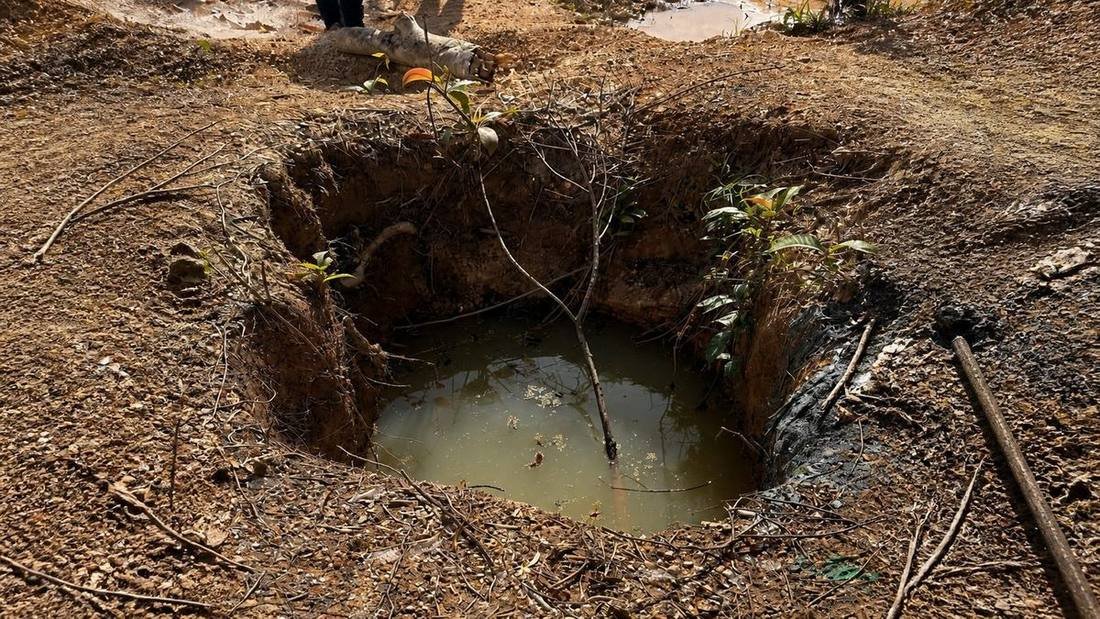
A few kilometers away, in Crucitas and on Las Conchuditas Hill, thousands of small-scale miners—the vast majority of whom are Nicaraguans—extract gold using mercury and cyanide from a territory that the government abandoned after the failure of the formal mining project. The abandoned extraction pits full of poisoned water and stripped clay soil, is all that is left behind.
The gold-bearing sediment crosses the border and ends up being processed by Chinese companies based on the Nicaraguan side, which extract a much higher proportion of gold from the material than artisanal miners, known as coligalleros do. The activity has expanded from about 900 hectares (2,200 acres) to more than 3,000 hectares (about 7,400 acres) in recent years. The migration route, the gold route, and the smuggling route are not three separate routes: they are the same infrastructure, managed by the same actors, affecting the same communities.
And therein lies the underlying problem—the one that connects this area to everything we have been observing in the region. In these towns and hamlets, communities have learned to respond to the state in the same way they respond to the criminal actors who control the routes: with a mix of necessity, calculation, and resignation. The coligallero is “a necessary evil” because without him, the general store cannot make sales. The coyote is both a threat and a provider of a service that the state does not offer. The boundary between what is legal and what is illegal ceases to be a moral line and becomes a matter of survival. This is extralegal governance, and it is also, increasingly, hybrid governance: not the absence of the state, but its silent fusion with the very dynamics it claims to combat.
This is what we describe within our framework as the fifth wave of transnational organized crime: structures that no longer impose themselves through spectacular acts of violence, but rather through their ability to embed themselves in local economies, become normalized, and blend into the landscape. Migration, in this model, is not an isolated humanitarian phenomenon; it is a criminal economic engine, with its own value chain, profit margins, and operators. And like any profitable economy, it creates incentives for formal actors—police, government officials, transport operators, merchants—to become part of it.
None of this would be visible without local guides. In Los Chiles, we were accompanied by a brave and meticulous Costa Rican investigative journalist who understands the border because he has walked it for years. His work helps provide the layer of information that is missing from official records and without which no investigation is possible.
But he practices his craft today in a country at a critical juncture. Costa Rica, which for years was the region’s democratic exception and a refuge for persecuted journalists from the rest of Central America, has seen a steady decline in press freedom rankings, driven by an official discourse that stigmatizes critical media, restricts access to information, and normalizes authoritarian narratives. The deterioration of democracy and the deterioration of conditions for investigating organized crime are not separate processes: they are the same process. When those who make the invisible visible are weakened, the corridor becomes even more opaque.
The work on the northern border leaves as many questions as conclusions. What does “the state” mean in a territory where the neighboring country’s currency circulates more freely than its own, where the police are both enforcers and accomplices, and where the community gauges its relationship with the formal state based on who controls the route that week? The answer does not lie in more operations or more rhetoric about sovereignty. It lies in understanding how these structures operate within their context, how they relate to people, and how they are embedded in both formal and informal economies. And in the will—increasingly under threat—to continue closely observing what has become, functionally, invisible.