During our fieldwork in northern Costa Rica we wanted to see the illicit gold mining destroying the tropical forests region. Instead we stumbled on both the environmental disaster resulting from clear cutting forests and pouring mercury into the water systems, coupled with the government’s capacity to stage an absurd political spectacle based on that tragedy.
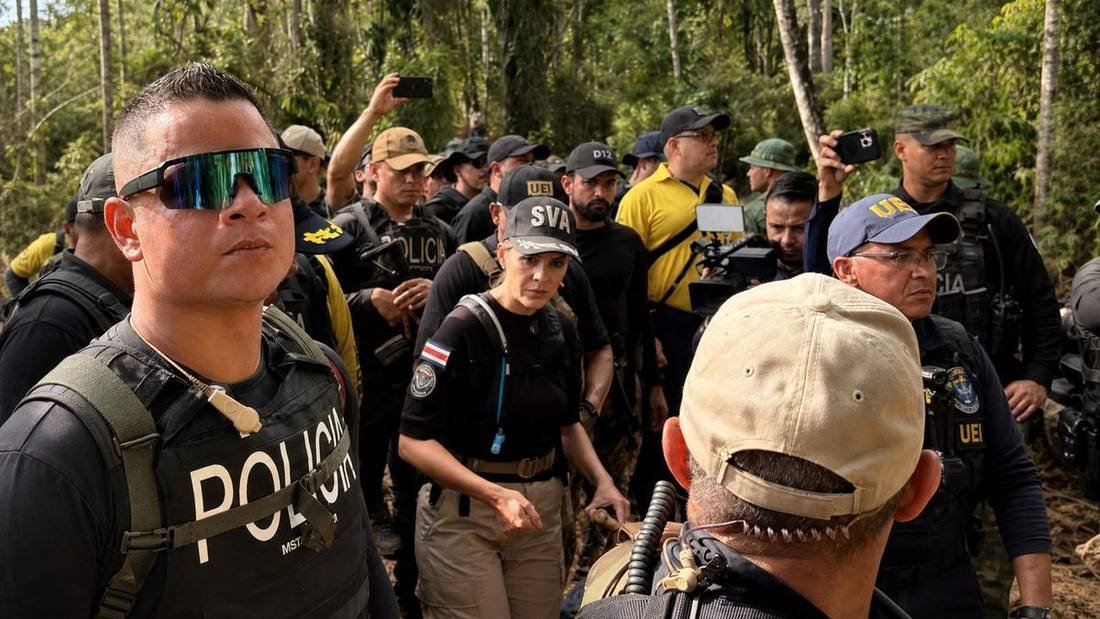
The day of our main visit to the mining area, President Laura Fernández had organized a tour of the zone with a specific goal: to pressure the Legislative Assembly to pass a bill that would reopen open pit gold mining through concessions for foreign corporations—an initiative blocked by more than six hundred opposition bills. Rather than a field trip, the president turned the event into a show of force, with helicopters and drones flying overhead, armored vehicles, tactical deployments, creating a media circus for the dozens of journalists and government propagandists who showed up for the event.
As the presidential entourage was preparing to board vehicles to a planned press conference after visiting the periphery of the mining area a distant explosion sounded, sending the security forces and journalists scurrying. The explosion, which the president later admitted was likely routine activity of illegal miners a distance away, gave the increasingly authoritarian government the narrative of a spectacle and threat that was very useful, whether preplanned or not.
What was carefully staged for the event was the narrative. Alongside the journalists covering the tour was a group government social media propagandists dedicated to “explaining the truth”: that the crisis is serious, yes, but that the “leftists” are blocking every honest attempt by the government to resolve it. The explosion was portrayed as an attempt on the life of an heroic president fighting the forces of Communism. That framing—of a heroic executive branch facing a sabotaging, violent and corrupt opposition now a common trope of authoritarian governments—is effective precisely because it’s built on a real problem.
Therein lies the risk that concerns us most on the ground: when a genuine catastrophe is exploited as a political weapon, it not only distorts public debate but undermines the possibility of seriously investigating it. The spectacle confuses a population that deserves to understand what is happening and replaces knowledge and context with slogans.
It is therefore important to carefully separate the elements of the incident. The phenomenon of illegal gold mining exists and is causing an environmental catastrophe. It is not an exaggeration. In Crucitas and on Las Conchuditas Hill, thousands of gold miners—known as güiriseros on the Nicaraguan side, most of whom are Nicaraguan citizens—extract gold using mercury and cyanide, dig tunnels and pits, clear primary forest, and poison the riverine water systems. The area of mining activity has tripled in the past five years. The gold-bearing sediment crosses the border and is ultimately processed by Chinese companies operating on the Nicaraguan side.
The Costa Rican government allocates some $1.5 million a month and hundreds of police officers to an area where the gold miners even destroy the national boundary markers, and where the Nicaraguan currency, the córdoba has begun to replace the Costa Rican currency, the colón in everyday transactions. The environmental damage is evident, profound, and, for the most part, likely irreversible.
What does warrant scrutiny is the government’s response. The Fernández bill opens up the entire Cutris district—more than 800 square kilometers—for concession through auctions to the highest bidder, and it reverses the national ban on open-pit metal mining that has been in effect for fifteen years.
The proposed royalties paid to the state are set well below regional noema. Under the rules of the bidding process, the very company that sued the country over the old Crucitas project could bid again. Universities, environmental prosecutors, and scientists have warned that the initiative, far from curbing illegal mining, would encourage a “mining swarm” across a much larger territory. That the proposed solution to a problem of illegality is to legalize the expansion of the very activity that has caused the crisis it is, to say the least, a paradox.
And here, the Costa Rican case ceases to be a local issue. What we saw in Crucitas is the Central American vanguard of a transformation that has already redrawn the criminal map of the Amazon basin. Fernández’s mentor, President Nayib Bukele in El Salvador, is pushing Costa Rica’s mining law as he has installed new mining operations in his own country, despite the fact that in El Salvador all mining is prohibited.
In Peru, Ecuador, Colombia, Brazil, and Venezuela, illegal gold has become a criminal economy more profitable than cocaine: it generates quick profits, is easily laundered, and once melted down, is virtually impossible to trace. The same routes, the same financial structures, and the same systems of corruption that once served the drug trade now serve gold, timber, and human trafficking. This will be replicated in Costa Rica, with porous borders abutting a criminal regime in Nicaragua specialized in the illicit gold trade as surely as night follows day. Organized crime, already embedded in the trade, will no forego such an opportunity.
The key to criminal expansion lies in the cross-border routes. There isn’t a separate route for gold, another for migrants, and yet another for drugs: there is a single infrastructure that drives multiple criminal economies, managed by those who control the territory. And to gain a foothold in that corridor, transnational networks don’t need to conquer it—they need a reliable local partner, someone who knows every trail, every blind spot, and every corruptible official. They need a route manager. Costa Rica already has criminal leaders with that capability, and they are likely the most reliable allies a complex group could hope for today.
The most illustrative case is that of Alejandro Arias Monge, alias “El Diablo,” identified by Costa Rican authorities and the DEA—which is offering half a million dollars for his capture—as the country’s most wanted drug trafficker. It is no coincidence he is believed to be in the jungles along the border with Nicaragua, the same corridor through which the gold from Crucitas and the migrants from Los Chiles flow. His organization, with a documented presence in a dozen towns in the Caribbean and northern regions—Pococí, Guácimo, Sarapiquí, San Carlos, Upala, and Los Chiles itself—also operates under a model that authorities describe as a “brand”: other criminals conduct their own business as franchises of his operation because his reputation commands respect and opens up markets. That is, precisely, the anatomy of a mature route operator: territorial control, local reach, the ability to outsource violence, and a brand that reduces coordination costs for any external actor wishing to use the corridor.
The work in Crucitas provides answers but sharpens the questions. While the state stages a spectacle over who will get the concession, the route managers quietly consolidates their control power. What does it mean to govern a territory where gold, cocaine, migrants, and the “brand” all travel the same river, and where the main public dispute is over control of the narrative rather than control of the territory? The answer lies neither in the spectacle nor in the influencers, but in the willingness to look closely at what the spectacle is designed to keep us from seeing.